

By Bertha Hurtado, Founder & Owner
If you’ve ever held a raw coffee bean, you know it doesn’t look like coffee at all. It’s pale green, hard as a little pebble, and it smells more like a hayfield than a café. You could grind it and brew it, but I wouldn’t recommend it.
And yet everything we love about coffee is already inside that little seed, waiting. Heat is what wakes it up. So what happens to a coffee bean when it roasts? In a matter of minutes, a quiet green seed becomes a brown, fragrant bean holding more than 1,000 aroma compounds.
First, a small confession: I’m not a chemist, and I’m not the one roasting our coffee. I leave that to our roaster, who is far better at the task. What I am is endlessly curious.
I come by it honestly. My dad is a materials science engineer, and he treated every cup of coffee like a small experiment worth getting right. Years later, forensic anthropology taught me to slow down and pay attention to the smallest details, because that’s usually where the truth is hiding. Coffee rewards that same kind of attention.
So every few weeks, I’ll take one question about coffee and try to answer it the way I would at the window: simply, honestly, and with real research behind it. I even made a few charts.
Meet the green bean
A coffee bean is really the seed of a fruit, the coffee cherry. After harvest, the seeds are dried and shipped green, still holding about 10 to 12% water (Lavazza).
Inside, it’s a pantry of possibility: sugars, amino acids (the building blocks of protein), acids, and oils. Chemists have counted more than 300 aroma compounds in green coffee. After roasting, there are more than 1,000 (Suslick et al., Analytical Chemistry, 2010).
I love that. Roasting doesn’t add flavor to a bean. It coaxes out what was there all along.
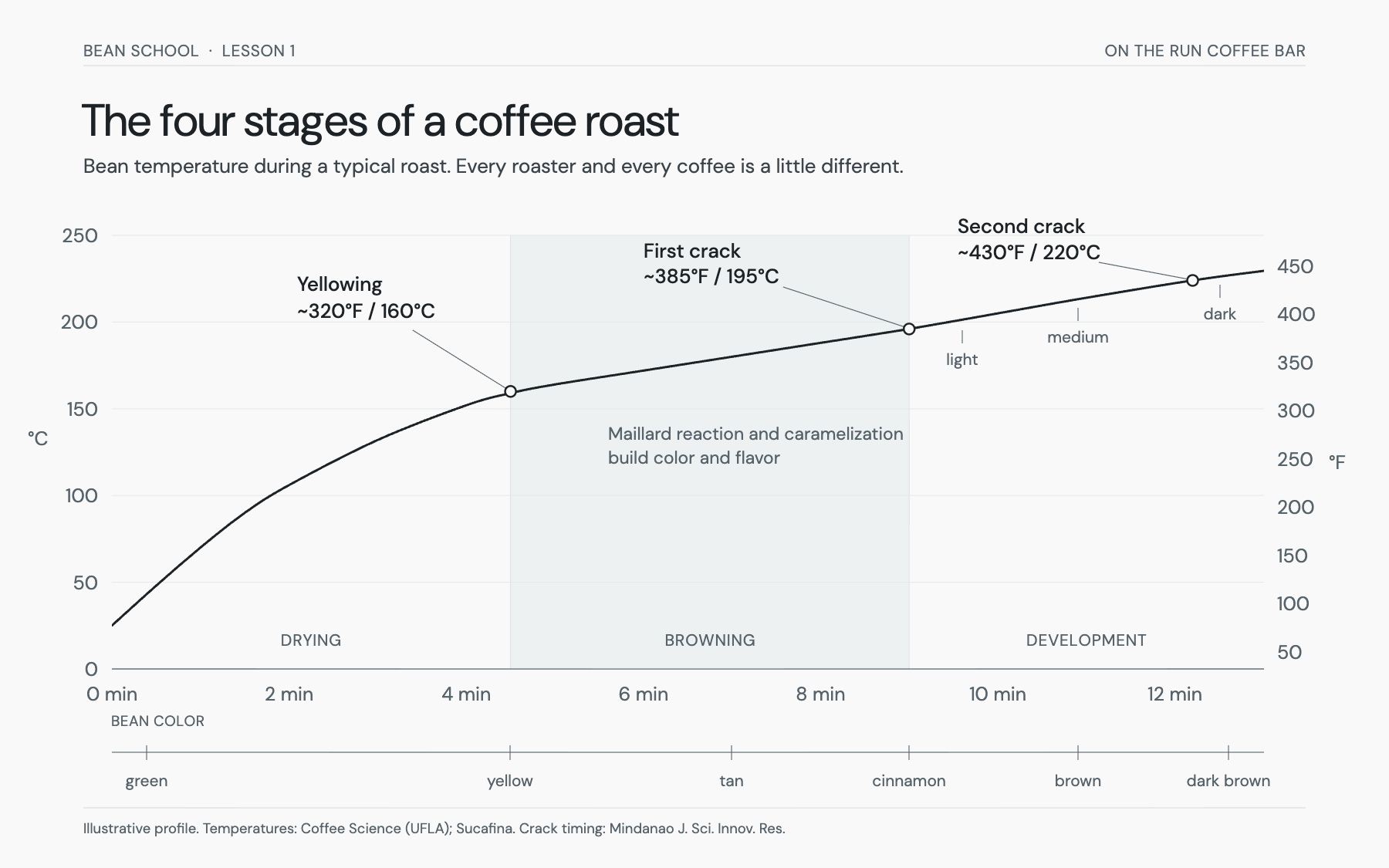
The four stages of a roast. This is an illustrative profile; every roaster and every coffee is a little different.
Stage 1: Drying
The roast begins patiently. As the bean warms toward about 320°F (160°C), its water slowly evaporates, and its color softens from green to a pale straw yellow (Lavazza). Nothing dramatic happens yet, and that’s the point. The big flavor reactions can’t really begin until most of the water has gone (Sucafina).
Stage 2: Browning
This is my favorite part, because it’s chemistry you already know by heart. Once the bean passes about 285 to 300°F (140 to 150°C), the Maillard reaction begins (International Journal of Food Science & Technology, 2023). It’s the same reaction that gives toast its color, bread its crust and a steak its sear. If you’ve ever stood in a kitchen and breathed in something browning, you’ve already met it.
In the Maillard reaction, sugars and amino acids react in a long, tangled chain of steps. Along the way, they create hundreds of new flavor compounds, plus brown pigments called melanoidins that give coffee its color (America’s Test Kitchen). Nutty, toasty, chocolatey: this is where those notes are born.
At the same time, the sugar caramelizes, just as it would in a pan, and it doesn’t last long. In a 2019 study, researchers measured the sugar in Brazilian beans every minute of a medium roast. It fell from 70.1 to 3.0 milligrams per gram, and most of it disappeared in just three minutes (Diviš et al., 2019).
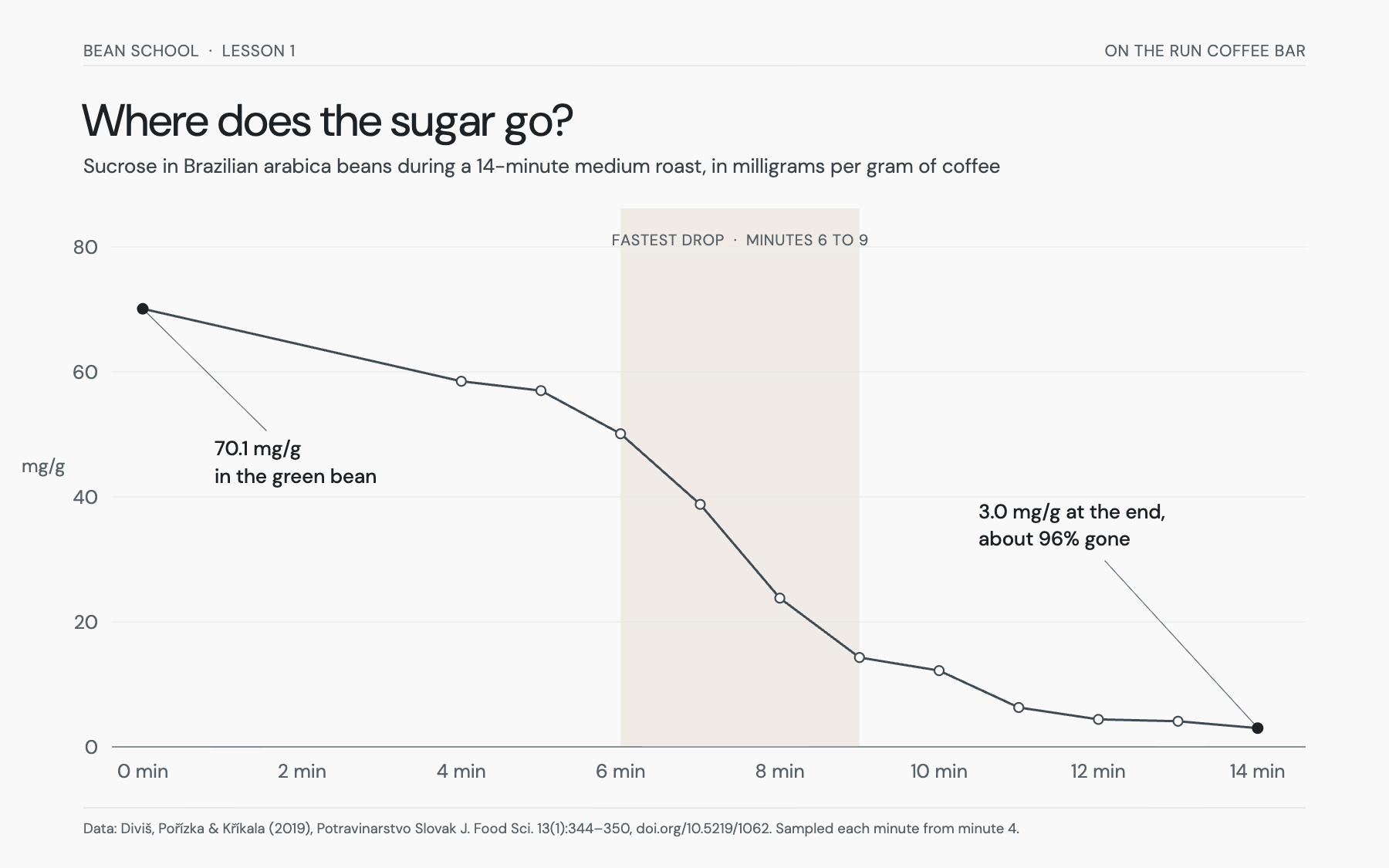
Sugar in the bean during a medium roast. Data: Diviš et al., 2019.
So the sweetness in your cup isn’t really sugar anymore. It’s sugar, transformed.
Stage 3: First crack
All this time, the water inside each bean has been turning to steam, and the pressure keeps building. At around 375 to 390°F (190 to 200°C), the bean finally gives way. It cracks open with a small pop you can actually hear, a lot like popcorn (Coffee Science, UFLA).
Roasters listen for this sound the way a musician listens for the downbeat. First crack marks the beginning of a light roast. From here, every minute changes the cup, and the roaster has to decide when to stop. I find that a little beautiful: all that science, and in the end it still comes down to a person’s judgment and a good ear.
Stage 4: Development and second crack
After first crack comes development, when the flavors built during browning keep deepening and finding their balance (Sucafina). Medium roasts usually finish somewhere in here.
Let the roast continue, and at around 430°F (about 220°C), the beans pop a second time (Sucafina). By now, the bean’s structure is breaking down, and its oils are rising to the surface (Stoica et al., 2020). That’s why dark-roast beans often shine, and why they taste bold, smoky and bittersweet.
What a roast uses up
This is where the scientist in me gets a little giddy. In a 2025 study, researchers roasted the same Colombian coffee to five levels, from light all the way to a very dark Italian roast, and measured what was left of the green bean in each one (Ali et al., 2025).
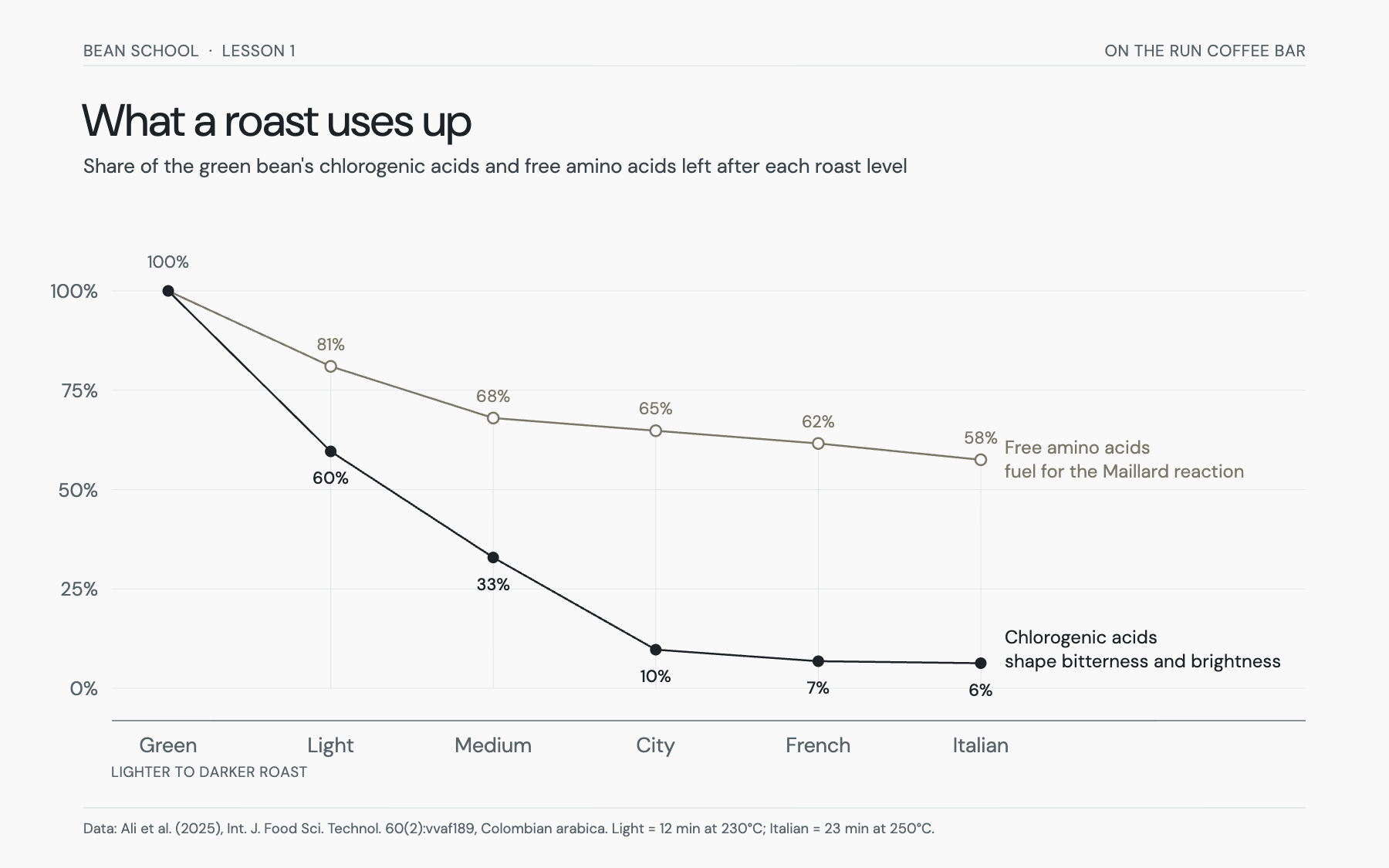
What’s left of the green bean’s chlorogenic acids and amino acids at each roast level. Data: Ali et al., 2025.
Two things stood out to me:
Chlorogenic acids fade fast. If you read my post on chlorogenic acid, you know these acids help shape coffee’s brightness and bitterness. A light roast kept about 60% of them, a medium roast about a third, and the darkest roast only 6%. As they break apart, they form smaller compounds, and some of those taste bitter (a 2024 roasting study).
Amino acids get spent like fuel. About 40% were gone by the darkest roast, much of that used up by the Maillard reaction that built the flavor.
I think this explains something we’ve all tasted. Light and dark roasts don’t just taste different. By the end, they’re made of different things.
Lighter, but bigger
When the roast is done, the bean that comes out is not the bean that went in.
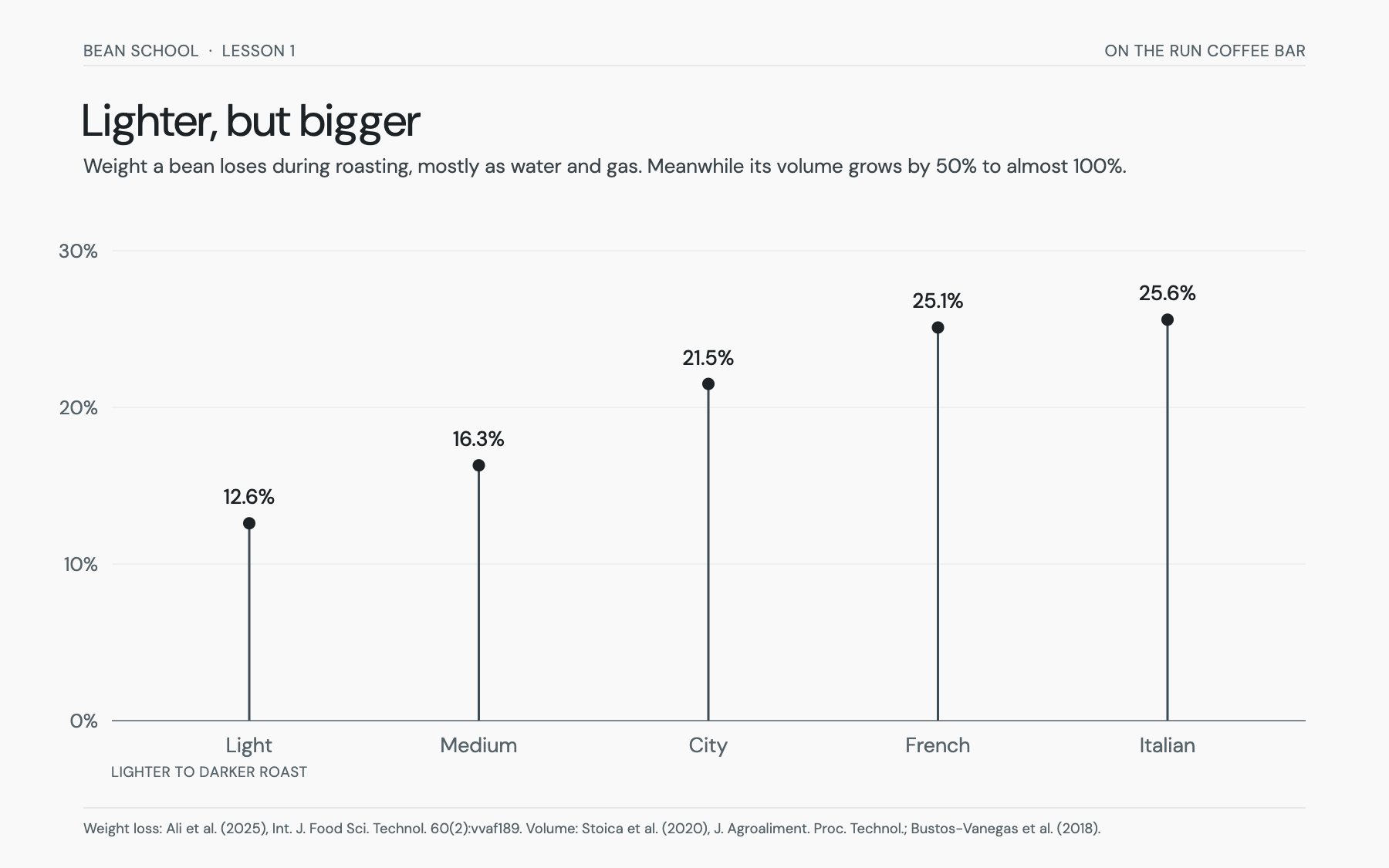
Weight lost at each roast level. Data: Ali et al., 2025.
It weighs less. In that same 2025 study, light roasts lost about 13% of their weight, and the darkest lost almost 26%, mostly as water and gas (Ali et al., 2025).
It grows. Even as it loses weight, the bean puffs up, gaining about 50% to almost 100% in volume (Stoica et al., 2020). In one X-ray study, beans swelled to as much as 1.8 times their original size (Bustos-Vanegas et al., 2018).
It holds its breath. The Maillard reaction makes a lot of carbon dioxide (Wang & Lim, 2017). Some of it stays trapped inside the bean and slowly escapes over the following days, and darker roasts hold more of it (Wang & Lim, 2014). That deserves a lesson of its own, so I’ll save it.
What it means for your cup
If you take one thing from this lesson, I hope it’s this: roasting is a balancing act. Stop early, and the bean keeps more of where it came from, the bright, fruity and floral notes shaped by the soil, the altitude and the hands that grew it. Keep going, and the roast starts to speak louder than the farm, with deeper, toastier, more bittersweet flavors. Neither one is wrong. They just tell different stories.
That’s why I care so much about where our coffee comes from. Our roaster traces every bean we serve back to the specific farm where it was grown, and a good roast doesn’t cover that story up. It lets you taste it.
The next time you visit us at Emily’s Garden or at DHL HQ in Plantation, take a slow breath when we grind your beans. Everything you smell came from a few minutes of heat, a lot of chemistry, and someone who cared enough to get it right.
Your Bean School homework
Next time, we’ll pick up right where we left off: light, medium or dark? What each roast tastes like, and whether dark roast really has more caffeine. (The answer might surprise you.)
Until then, I’d love to hear from you. How do you like your coffee roasted? Tell me on Instagram at @on_theruncoffee_bar, or better yet, tell me at the window. I’m always happy to talk coffee, and I learn something new from all of you every day.
See you in class,
Bertha
Want to go deeper? A few good science reads
Poisson, Blank, Dunkel & Hofmann, “The Chemistry of Roasting: Decoding Flavor Formation” in The Craft and Science of Coffee (Academic Press, 2017). This is the textbook chapter on roasting chemistry. Read it here
Schenker et al., “Pore Structure of Coffee Beans Affected by Roasting Conditions,” Journal of Food Science (2000). A classic study of how beans puff up and turn porous. Read it here
Smrke et al., “Time-Resolved Gravimetric Method to Assess Degassing of Roasted Coffee,” Journal of Agricultural and Food Chemistry (2018). It follows the gas escaping from fresh beans. Read it here
Coffearium is a free, plain-English coffee science encyclopedia, and every entry links to its studies. Visit Coffearium
Sources
Suslick, B. A., Feng, L. & Suslick, K. S. (2010). Discrimination of complex mixtures by a colorimetric sensor array: coffee aromas. Analytical Chemistry. https://www.ncbi.nlm.nih.gov/pmc/articles/PMC2947826
Diviš, P., Pořízka, J. & Kříkala, J. (2019). The effect of coffee beans roasting on its chemical composition. Potravinarstvo Slovak Journal of Food Sciences 13(1), 344–350. https://doi.org/10.5219/1062
Ali, M. et al. (2025). Modulating bioactive compounds and antioxidant potential in coffee beans: impact of roasting on amino acids, phenolics, proteins, and caffeine. International Journal of Food Science & Technology 60(2), vvaf189. https://academic.oup.com/ijfst/article/60/2/vvaf189/8262800
Effects of postharvest processing on aroma formation in roasted coffee. International Journal of Food Science & Technology 58(3), 1007 (2023). https://academic.oup.com/ijfst/article/58/3/1007/7807986
Study of variations in the roasting time of Gayo arabica coffee. Coffee Science (Universidade Federal de Lavras). https://coffeescience.ufla.br/index.php/Coffeescience/article/download/2085/2413
Impact of roasting conditions on physicochemical, taste, volatile and odor-active compound profiles of coffee (2024). https://pmc.ncbi.nlm.nih.gov/articles/PMC10818202/
Stoica et al. (2020). Effect of ground and roasted parameters on the microstructure of coffee. Journal of Agroalimentary Processes and Technologies. https://www.josa.ro/docs/josa_2020_4/b_01_Stoica_957-968_12p.pdf
Bustos-Vanegas, J. D. et al. (2018). Developing predictive models for determining physical properties of coffee beans during the roasting process. https://locus.ufv.br/items/9020a70e-c1e4-4026-99c8-36c619f6b648
Wang, X. & Lim, L.-T. (2017). Investigation of CO2 precursors in roasted coffee. Food Chemistry. https://pubmed.ncbi.nlm.nih.gov/27765215/
Wang, X. & Lim, L.-T. (2014). Effect of roasting conditions on carbon dioxide degassing behavior in coffee. Food Research International 61, 144–151. https://agris.fao.org/search/en/providers/122535/records/65de46014c5aef494fdb644f
Mindanao Journal of Science and Innovation Research. Effects of roast levels on the physical properties of coffee (first crack at minute 9, second crack at minute 12; used for chart timing). https://journals.bsu.edu.ph/mjsir/article/download/338/393/984
Sucafina, “Chemical Reactions in Roasting.” https://sucafina.com/na/news/chemical-reactions-in-roasting
America’s Test Kitchen, “The Science of Coffee Roasting.” https://www.americastestkitchen.com/articles/7655-the-science-of-coffee-roasting
Lavazza, “Light vs. Medium vs. Dark Roast.” https://www.lavazzausa.com/en/recipes-and-coffee-hacks/light-medium-dark-roast-guide
